How to Practise Lash Extensions as a Beginner
Learning the theory behind eyelash extensions is important, but becoming confident with lashes comes from practise.
When you first start, isolation can feel awkward, your tweezers may not seem to cooperate and even placing one extension correctly can take much longer than expected. This is completely normal.
Lash application is a practical skill. Your hands need repetition before the movements begin to feel natural.
The key is not simply practising as much as possible. It is practising the right things in the right order, so you develop good habits rather than repeating mistakes.
Here is how I recommend practising lash extensions when you are a beginner.
Start With the Foundations Before Full Lash Sets
One of the biggest mistakes beginners make is trying to complete beautiful full sets immediately.
Instead, break lash application into smaller skills.
Before worrying about styling or speed, practise:
holding and controlling your tweezers
separating individual lashes
picking up extensions
controlling the amount of adhesive
placing extensions accurately
maintaining consistent direction
creating clean attachment at the base
Once these individual movements become easier, putting them together into a full set becomes much less overwhelming.
Practise Using Your Tweezers
Your tweezers will probably feel unfamiliar at first.
Spend time learning how much pressure you need to open and close them and where the most comfortable grip is for your hand.
You can practise picking up individual lash extensions from a strip and placing them down accurately without even using adhesive.
This simple exercise helps develop hand-eye coordination and control.
Try not to grip your tweezers too tightly. Excess tension in your hands can make precise movements more difficult and may become uncomfortable during longer appointments.
Practise Isolation Separately
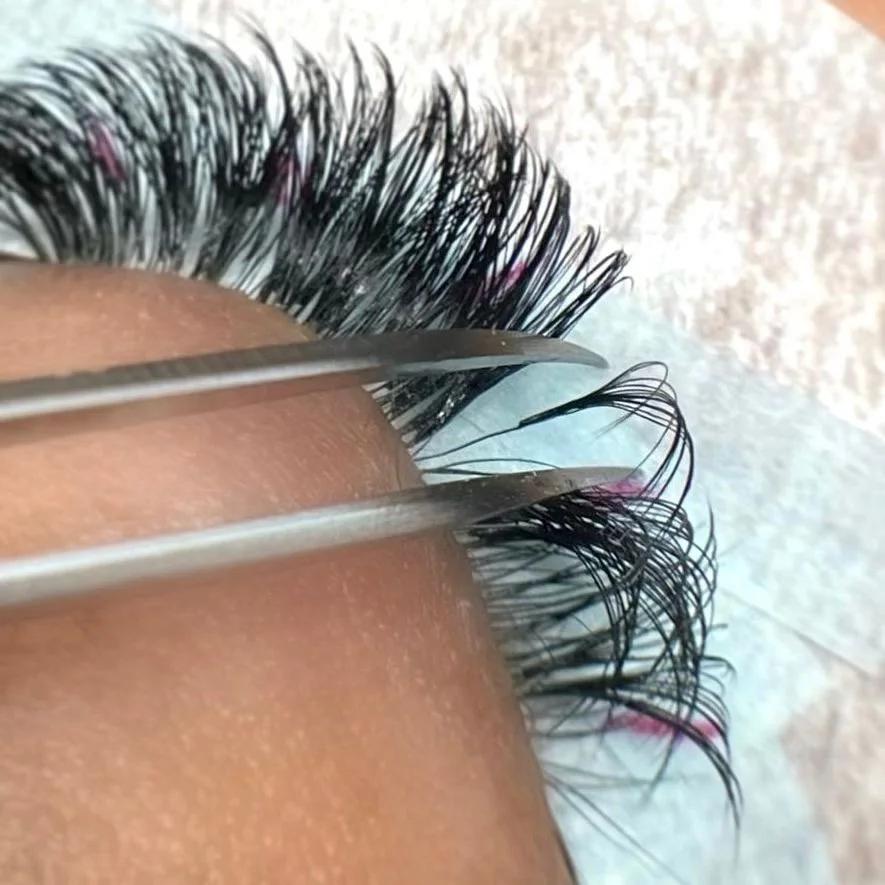
Good isolation is one of the most important skills in eyelash extensions.
Each extension should be attached to an individual natural lash rather than accidentally sticking several natural lashes together.
Beginners often become so focused on placing the extension that they lose their isolation.
Spend dedicated practice time doing nothing except separating lashes with your isolation tweezers.
You can practise this on training lashes initially and then on a model once you are ready.
The faster and more confidently you can isolate, the easier your full sets will eventually become.
Use a Mannequin to Learn Basic Movements
A mannequin can be useful when you are completely new because there is no pressure to work quickly and you can stop whenever you need to.
It gives you an opportunity to practise your posture, tweezer control, pickup, isolation and placement.
However, mannequin lashes are not the same as real natural lashes.
Real clients have multiple layers of lashes, different growth directions, fine baby lashes and natural movement.
Think of mannequin practice as preparation for working on real people, rather than a replacement for live models.
Practise Placement Without Adhesive
Before introducing adhesive, you can practise picking up an extension and positioning it against a training lash.
Focus on controlling exactly where the extension lands and the direction it points.
This removes the pressure of adhesive curing while you are still developing basic coordination.
Once you feel more comfortable controlling the extension, begin practising with adhesive.
Learn to Control Your Adhesive
Using too much adhesive is a common beginner problem.
Your extension needs enough adhesive to create a secure attachment, but more adhesive does not automatically mean better retention.
Excess adhesive can create bulky bases and increase the risk of neighbouring lashes sticking together.
Practise dipping consistently and observe how much adhesive remains on the extension.
Your environment also affects how adhesive behaves, so understanding your particular adhesive and its recommended working conditions is important.
Move Onto Live Models
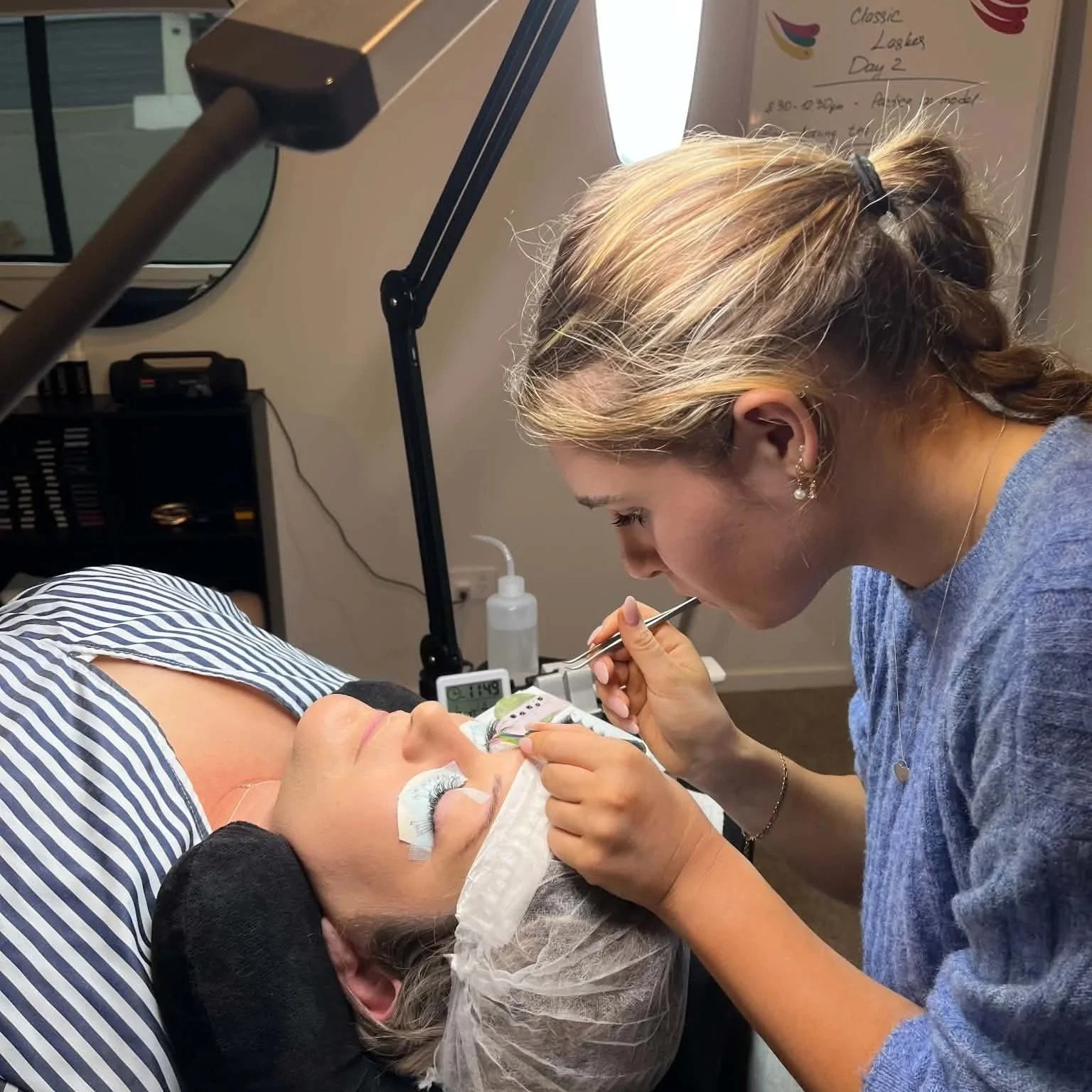
Once you understand the basic movements, start practising on real models.
Friends and family members can be ideal during this stage because they usually understand that you are learning and your appointments may take longer.
Explain clearly that you are practising and allow plenty of time.
Your early goal should be safe, clean application rather than completing an extremely full set.
Working on real natural lashes teaches you things a mannequin cannot, including how to work with different lash layers, directions, eye shapes and natural lash densities.
Don't Worry About Speed Yet
Beginners often become concerned when a lash set takes several hours.
Speed should not be your main priority at the beginning.
Trying to work faster before you have good control can lead to poor isolation, messy placement and inconsistent direction.
Focus first on:
safe isolation
correct placement
clean attachment
appropriate lash selection
consistent direction
Speed develops naturally as your movements become more familiar.
It is much easier to make good technique faster later than to correct fast but poor technique.
Take Photos of Every Practice Set
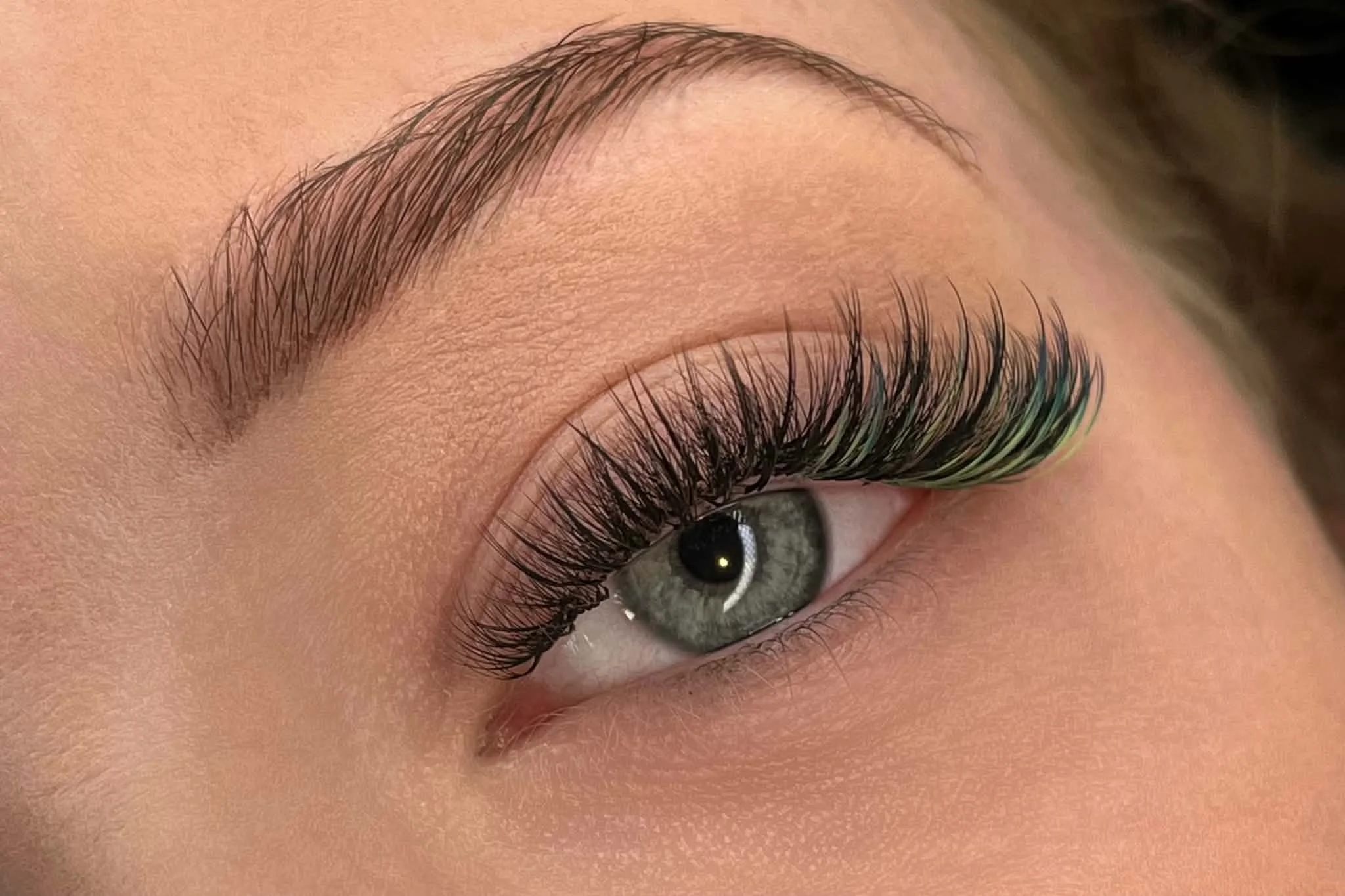
Photograph your work after every model.
Photos allow you to see things you may not notice while you are concentrating on application.
Take photographs from several angles, including from above with the client's eyes closed if possible.
Look at:
overall shape
symmetry
direction
coverage
inner and outer corners
consistency across the lash line
Keep your early photos rather than deleting them because you are unhappy with the result.
Comparing your work several weeks or months later can show you how much your technique has improved.
Ask Your Educator for Feedback
Practising alone can make it difficult to recognise technical problems.
This is why access to educator support is so valuable.
Send clear photographs of your work and ask specific questions.
Instead of simply asking, “Is this good?”, ask about the area you are struggling with.
For example:
“Does my direction look consistent?”
“Am I using too much adhesive?”
“Why are my outer corners dropping?”
Specific questions make it easier for your educator to give useful feedback.
My Online Lash Course includes personal support so students can ask questions and receive guidance while they practise.
Correct Mistakes Before They Become Habits
Repetition helps you improve only when you are repeating the correct technique.
If you repeatedly practise poor isolation or incorrect placement, those movements can become habits too.
When you identify a problem, slow down and deliberately work on correcting it.
Sometimes it is more useful to spend one practice session concentrating on a single weakness than completing another entire set.
Quality of practise matters more than simply counting hours.
Practise Consistently Rather Than Occasionally
You do not necessarily need to practise every day.
Consistency is more important.
Practising regularly keeps the movements familiar and allows each session to build on the previous one.
If several weeks pass between practice sessions, you may feel like you are relearning the same movements each time.
A realistic schedule could be one or two dedicated practice sessions each week, depending on your other commitments and access to models.
The important thing is choosing a routine you can maintain.
Focus on One Improvement at a Time
Trying to improve everything simultaneously can become frustrating.
After each practice set, choose one or two things to focus on next time.
For example:
Practice set 1: isolation.
Practice set 2: attachment and adhesive control.
Practice set 3: direction.
Practice set 4: inner and outer corners.
Practice set 5: styling and symmetry.
You will still use all your other skills during each set, but having one main focus makes progress easier to evaluate.
Practise Different Areas of the Lash Line
Beginners often find the middle of the eye easiest and the inner and outer corners more difficult.
Do not avoid the difficult areas.
Inner corners require precise isolation and usually involve shorter, finer natural lashes.
Outer corners can be challenging because natural lashes may grow sideways or downward.
Spend additional time practising these areas rather than always concentrating on the easiest part of the eye.
Practise on Different Models
Once you become comfortable with your first few models, try working on different people.
Every client has different natural lashes.
Some have very fine lashes, some have dense lash lines and others have lashes growing in several directions or layers.
Working on different models teaches you to adapt rather than becoming comfortable with only one person's lashes.
It also helps you understand why the same lash map does not suit everyone.
Learn to Check for Stickies
A “sticky” happens when two or more natural lashes become unintentionally attached together.
Checking for stickies should become part of your normal working routine.
As you practise, regularly move back through completed sections and separate any lashes that have become attached.
Do a thorough final check before finishing the set.
Good isolation protects natural lash health and is far more important than trying to achieve maximum coverage while you are still learning.
Don't Compare Your Beginner Work With Experienced Lash Artists
Social media can make learning feel harder than it actually is.
You may see perfectly photographed lash sets created by technicians who have been working for five or ten years and compare them with your third practice model.
That is not a useful comparison.
Compare your current work with your own previous work.
Are your bases cleaner?
Is your direction improving?
Are you isolating more confidently?
Is your application becoming faster without losing quality?
Those are much better measures of progress.
When Should You Start Charging for Lash Extensions?
There is no universal number of practice models that means you are automatically ready to charge.
Before taking paying clients, your work should first be safe.
You should be able to isolate correctly, avoid stickies, select appropriate extensions, control your adhesive and maintain suitable distance from the eyelid.
Your sets should also be becoming reasonably consistent.
Some beginners initially charge a reduced model price while they continue improving their speed and portfolio.
The important distinction is that clients should understand your current level of experience and what they are booking.
How Long Does It Take to Get Good at Lash Extensions?
Everyone progresses differently.
The amount you practise, the quality of your training, the feedback you receive and how deliberately you correct mistakes all influence how quickly you improve.
Do not expect to feel completely confident immediately after finishing a course.
Completing your training gives you the knowledge and techniques to practise. Confidence develops afterwards through real application.
If you are consistent, you may be surprised by how different your work looks after several months.
Keep Learning After Your Beginner Course
Your first lash course should give you a strong foundation, but there will always be more to learn.
Once your basic application becomes consistent, you can gradually develop your styling, improve retention, work more efficiently and learn additional techniques.
Do not rush into advanced training simply because you want another certificate.
Make sure you can confidently apply the fundamentals first.
If you are still choosing your initial training, my guide on how to choose your first lash extension course explains what beginners should look for before enrolling.
My Advice After 12+ Years in the Lash Industry
I have worked with lashes in New Zealand for more than 12 years and have trained lash students for 8 years.
One of the biggest differences I see between students who progress and those who remain stuck is not natural talent.
It is consistent, deliberate practise.
You do not need your first sets to be beautiful.
You need to understand what went wrong, correct it and try again.
Take photographs, ask questions, practise the difficult areas and give your hands enough repetition to develop the skill.
That process is what gradually turns beginner knowledge into professional technique.
Ready to Start Learning and Practising Lashes?
My Online Lash Course is designed for complete beginners and teaches Classic, Hybrid and Premade Volume techniques step by step.
You'll receive lifetime course access and personal support, so you can return to the lessons and ask questions as you continue practising and developing your skills.
